

WORKHOUSE BURIALS IN FOSTER HILL ROAD CEMETERY
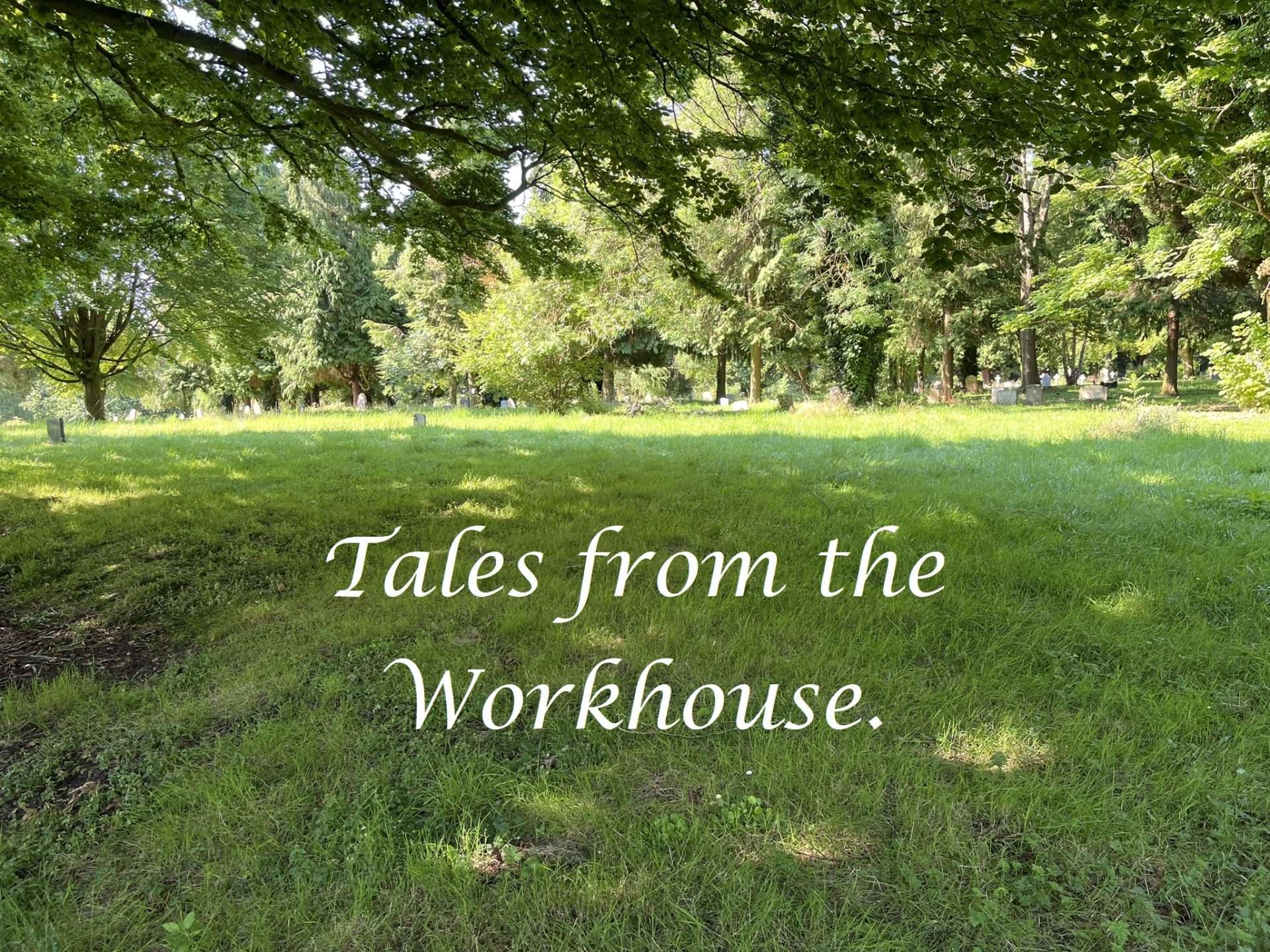
If you’ve ever walked in the top part of Foster Hill Road Cemetery, you may have wondered why there are so few gravestones in that area. Old maps of the cemetery reveal that the most expensive parts of the cemetery in which to be buried were near to the chapel, and the cheapest were those at the top of the hill. There are burials in almost every inch of the cemetery, but those at the top tended to be of poor people, including those who had to resort to living in the workhouse.
Sadly, almost all the graves of people who died in the workhouse are unmarked, so the Friends of Bedford Cemetery have started a project to research the stories of those forgotten people and allow them to be remembered just as much as the “great and the good” who do have gravestones.
Marion Palmann has been working on some of the 740 people we already know about who died in the workhouse and were buried at Foster Hill Road between 1855 and 1901.
Here are some of their stories…
ELIZABETH BALLS
Elizabeth was born in Wootton, Bedfordshire in 1845. Her parents were James Balls (or Ball) and his wife Sarah (nee Roberts). James’s family routinely interchanged the surname Balls with the surname Burton, which was his mother’s maiden name. The reason for this is unclear since his parents appear to have been married when James and his siblings were born. The intermittent use of the surname Burton was carried on by James and Sarah and their children also.
Elizabeth’s parents were married in Bedfordshire, but they later moved to Gedney in Lincolnshire, apparently following James’s parents. In the census of 1861 Elizabeth and her family were living in Gedney Drove End, but were not all in one house. Elizabeth was lodging with an elderly lady next door to the rest of her family, which at that time consisted of her parents and her younger brothers Thomas, Charles and George.
Elizabeth’s father died the following year, and Sarah and the children then sought parish relief at Gedney. A court order was obtained in April 1863 for the removal of Sarah and her three sons back to Bedford, as the family had not acquired legal settlement in Gedney (presumably because they had not resided there for long enough prior to James’s death). However, because Elizabeth was then 17, the court order did not extend to her.
Unfortunately it would appear that Elizabeth suffered from a learning disability, and her mother was distraught at the idea of leaving her behind, as she put it, “friendless”. She had no money to pay for a train ticket for Elizabeth. Her entreaties went unheard by the officials at the workhouse, but, determined not to abandon her daughter, Sarah went to the home of the lawyer who represented the workhouse, a Mr Ayliff, and knocked on his door. Mr Ayliff was holding a dinner party at the time, and he and his dinner guests were so affected by her entreaties that, between them, they collected up the sum of 10 shillings so that she could cover the cost of Elizabeth’s train fare to Bedford with her family. The money was passed to the Overseer, Mr Wilkinson, who accompanied the family on the train journey to Bedford. He bought tickets at each change of station for Sarah and the three boys, but not for Elizabeth, as she was not covered by the court order he was executing. He instead handed some of the donated funds to Sarah at each juncture, so that Sarah could pay for Elizabeth’s ticket, Elizabeth being incapable of doing so for herself. Mr Wilkinson therefore only indirectly facilitated Elizabeth’s travel.
On arrival at Bedford, the Overseers at Bedford were incensed to find five people claiming support instead of only the four named in the court order. Mr Wilkinson was immediately prosecuted for illegally imposing Elizabeth on the Bedford Union. Despite the fact that the money had been donated by well-wishers and had been handed to the mother, who herself paid for the ticket, he was found guilty of having caused Elizabeth to be delivered to the workhouse at Bedford, and was fined 40 shillings and costs.
When the family were taken into the Bedford Union House (workhouse), Elizabeth was described as “not able-bodied”. Within a year or so of her admission she was described as a “lunatic” and was said to be “quiet and harmless”. She was put to work in the workhouse laundry. She remained in the workhouse for the rest of her life.
In about May 1895 she suffered from a haemorrhage that had been so severe that they had not thought that she could survive. The doctor who attended her said later that it had been the worst case of haemorrhage he had ever seen. She did recover, and returned to her work in the laundry, but in the following July she suffered a serious scald to her arm that had made her very ill. Again she recovered and returned to her work. In early May of 1896 she had become sick and feverish and was confined to bed. She died two days later at the age of 51 on 8 May 1896, and was buried on 12 May 1896 at Foster Hill Road Cemetery, Grave Ref: B-80. At her inquest, the doctor who attended her said he thought she had been severely anaemic.
It is notable that in the early years of Elizabeth’s residence, she did have occasional days or weeks away from the workhouse, which may have been visits to her family. Her mother remarried in 1865, and had two further children. Elizabeth’s time out of the workhouse ceased around the time of the birth of the first of these children.
THOMAS BARBER
Thomas was born on 4 February 1820 in Cople, Bedfordshire, to James Barber, an agricultural labourer, and his wife Elizabeth, a lacemaker. Thomas had one older brother named George (b. 18 July 1818). The family were primitive Methodists, and his brother George became a Methodist preacher.
As a result of a youthful indiscretion in 1834 concerning the game laws, we have a physical description of Thomas as he was at age 15: he was 5 feet 5 1/2 inches tall, with “light” hair, hazel eyes and a fair complexion. He had a cut (presumably this means a scar) on the forefinger of his left hand.
Thomas earned his living initially as a farm labourer, but he demonstrated an impressive degree of flexibility, trying his hand at several occupations during his lifetime.
He lived in Cople with his parents, and later his widowed mother, until at least the age of 41. By the 1861 census he had changed his occupation to “fish dealer”.
He may have surprised his mother by marrying the following year, at the age of 42. His wife was Susanna Richardson, a farrier’s daughter from Bedford. The couple were married at Clerkenwell in London. Susanna was 44. Thomas was then described as a general dealer, so appears to have branched out from simply dealing in fish. At some point the couple went to live in Moggerhanger.
Thomas seems to have had a number of brushes with the law over the years, as a result of which we are able to follow some of the ups and downs in his fortunes.
In 1864 he was summoned before the bench for releasing an impounded pony. Presumably he had allowed his pony to stray, and it had been taken to the pound as a result: by releasing it surreptitiously he would have been avoiding the consequent fine. There was insufficient evidence on that occasion and he was acquitted.
In October 1865 he had a stall at Bedford fair at which he was selling his fish, and was on the receiving end of a rascal who both smashed a plate and underpaid for some salmon, and then punched Thomas in the face. The man, who had been drunk, was fined 10 shillings with 11 shillings costs, and apologised to Thomas for what had occurred.
In 1867 Thomas got into a scuffle at a beer house when he heard someone call him “Barber Mackerel” (no doubt on account of his occupation) to which he took strong offence. Punches were thrown, and although Thomas gave a long and (what was described as) “rambling” explanation to the effect that the charge “had been got up in spite to make him pay”, he was found guilty and fined 5 shillings and costs.
During 1868 Thomas’s wife, Susanna, was admitted to the Bedford Union House (the workhouse) for 4 days, the records suggesting a mental illness that was sadly to recur in later years.
By the census of 1871 the couple were still living in Moggerhanger, and Thomas was described as a “gardener”, which in this context meant market gardener.
In the same year, Thomas was summoned before the magistrates once more for allowing a horse to stray, this time onto the road outside a beer house in Cardington whilst he was inside having a drink. He was fined.
A similar infraction occurred, again outside an inn this time in Cauldwell Street in Bedford, the following year. He took it rather personally that the constable had caused him to be summoned before the bench for it instead of merely giving him a shout to come out of the inn and secure the horse. Again he had to pay a fine.
In July of 1876 Susanna was admitted to the Three Counties Asylum in Arlesey, and Thomas was ordered to pay 3 shillings per week towards her upkeep. Some interesting information about this asylum can be found here: Three Counties Asylum .
In December of the same year Thomas was charged with refusing to quit an inn at Chalton when ordered to do so by the licensee. He had had too much to drink and was said to be throwing punches. During the incident he also knocked a man unconscious. He was committed to gaol for 2 months for refusing to leave the inn, and was told he would be charged with the assault once his prison term had been served.
He was duly charged in the following January 1877 with the assault, and was convicted and fined 1 guinea including costs. It would appear that the magistrates took a more serious view of refusing to leave a public house when told to do so than of knocking a man senseless. At this time he was still earning his living as a market gardener.
At the end of May in the same year he was brought before the magistrates for having failed to pay his weekly contribution of 3 shillings towards Susanna’s upkeep. Once again he was reported to have made a lengthy and “rambling” explanation about his straitened financial circumstances, and said it was impossible for him to keep up the payments without being ruined, partly due to the swingeing interest he was having to pay on a loan of £300 he had had to take out. The magistrates told him that unless he paid they would send in the bailiff to seize his goods . It cannot therefore be a coincidence that by 16th June he had taken the drastic step of putting all his worldly goods up for auction.
As a result of this we can know that Thomas was possessed of 20 store pigs in a thriving condition and an acre of standing barley, as well as over 100 “useful items of furniture and personal effects”.
By August 1879 his premises were also being sold, from which we can discover that he had 2 acres of garden (i.e. market garden) land with a residence, and had an extensive frontage to the road leading from Blunham to Moggerhanger. It was stated that the purchaser would be entitled to immediate possession, so Thomas had clearly come to the end of his market gardening days. He was by now aged 59.
Sadly for poor Thomas his luck was not about to improve: in the December of that year he was knocked down by a passing vehicle as he left a shop in St Mary’s in Bedford and suffered a broken leg. He had to be conveyed to the infirmary in a truck by a constable.
By the census of 1881 Thomas was lodging with a Mary Ann Brown in Chalton Road Cottage, Chalton Road, Blunham. He was recorded as married, but Susanna was not with him. She was to be found as a resident in the asylum at Arlesey.
By 1891 he had moved to the parish of St Paul in Bedford, and was living as a lodger at the Saracen’s Head inn in St John’s street in the parish of St John. He was now recorded as being a green grocer. Business was perhaps not thriving, however, because later in the same year he needed to apply for parish relief to make ends meet.
By early autumn of the following year Thomas needed to be admitted to the workhouse as an inmate, and he remained there until his death on 21 August 1895. He was buried on 23 August 1895 at Foster Hill Road Cemetery, Grave Ref: A-1068. Susanna appears to have outlived him by about 5 years, after spending some 34 years in the asylum where she died in 1900.
HANNAH BAZZELL
Hannah was born in about 1825 in Gravenhurst, Bedfordshire, where she was baptised on 14 August 1825. She appears to have been a Roman Catholic, according to workhouse records. Her parents were Henry Bell and his wife Ann (or Hannah); records are scant, and it would appear that Hannah was cast on her own resources from quite a young age. Her year of birth is later frequently given as 1817 or 1818 but is most likely to be closest in the 1841 census where her age was given as 15.
At that time she was in Common Street in Pavenham with the family of a hat maker named Charles Hulatt. She was described as an “inmate”, indicating that she was an inmate of the workhouse who had been boarded out with a family.
During 1847 she had several admissions to the Bedford Union House (the workhouse) and was described as a lacemaker. On 10th December 1846 Hannah was admitted to the Bedford Union House (the workhouse) by reason of pregnancy, and was described as a servant. There is no clear record of any baby afterwards, however, so there may have been a stillbirth.
In 1851 Hannah was living in Pavenham in the household of William Hipwell, another hat maker, and was again referred to as a servant. About 12 months later in March 1852 she gave birth to a daughter, Matilda Ann (Bell), in the Bedford workhouse. Matilda was baptised on 18 July 1852 in Pavenham. It would appear that Hannah instituted successful paternity proceedings against a young man named James Ward of Pavenham. However, he did not pay the weekly sum that the court had ordered for the maintenance of the baby, and was prosecuted in January 1853 and ordered to pay what was due.
Hannah and Matilda were in and out of the workhouse repeatedly during 1853, when Hannah was described as “able bodied”, suggesting that Hannah was without a home.
In October of that year she was prosecuted for her part in the theft of a mantle on the night of the Bedford Fair. She was ultimately acquitted, but during the proceedings she had called upon John Bazzill (also spelt Bazzell, Bassill, Bassell), a cap maker, to give evidence of her movements on the evening in question, and he told the court that she lived in his household as his housekeeper. We can therefore pinpoint fairly closely the date by which Hannah had moved into John Bazzill’s household in Bedford.
John Bazzill was at that time married to Bithia (nee Shepherd), whom he had married in his home county of Devon in 1824, and who was the mother of his then adult daughter, Frances. Notwithstanding his marriage to Bithia, he was apparently living with Susannah Bonney (calling herself Susannah Bazzill) with whom he had had a daughter, Susan, in 1848, a daughter Ann Maria in 1850 and a son, John, in 1852. There is no record of any marriage between John and Susannah but in 1851 they were living in Gravel Lane in Bedford, and both of them were described as cap makers. All of their children had the surname Bazzill. Their son John died as an infant in about January 1853, and Susannah died in March 1853 – Bithia still being very much alive. It would appear that Hannah then moved in shortly afterwards, with Matilda.
A child was born to Hannah and John soon after this and died, but the records are not have not been found (the existence of the child being disclosed in a newspaper report).
There then followed a most bizarre occurrence. Hannah had given birth to another child, Albert, in about April 1855, whilst the couple were living in Bamford Court in Bedford. The baby had died of convulsions in the arms of a neighbour, when he was two weeks old. However, neither John nor Hannah had taken any steps to bury the baby, whose body was (according to the newspaper report) left undisturbed in the house for a week. The authorities investigated (on a “tip off”) and discovered the circumstances. A post mortem confirmed that death had been due to convulsions.
John’s wife Bithia died in the workhouse in April 1860. By the census of 1861 John and Hannah were living at Gravel Lane, and both of them were described as a cap makers. Both Ann Maria and Matilda Ann were living with them.
In the last quarter of that year Hannah gave birth to another son, John Henry, and it would appear that he was registered under the surname of “Bell”. Hannah and John were finally married on 30 July 1862 at St Paul’s church in Bedford, and their marriage was announced in the Bedfordshire Times and Independent – Tuesday 05 August 1862.
A daughter, Ada Amy Mary Bazzill was born on 18 November 1869 but died shortly after birth. Thus, in the 1871 census at their home in Gravel Lane there were John (now a comb maker) and Hannah (a charwoman) with Susan (also a charwoman) and young John, who was at school.
John Snr. became ill with lupus by 1876 and was unable to work, so that the family needed to apply for parish relief. This was granted, although when he returned to ask for more because of Hannah’s illness it was refused, and it was noted that she merely had a cold.
By 1881 John was described as an invalid. Hannah was still a charwoman, Ann Maria was a shopkeeper and John Junior’s occupation was drover. They were still at 26 Gravel Lane.
John died at home in November 1883. Their son John Henry died in June 1885.
Hannah continued to need parish relief, and in 1886 she became an inmate at the workhouse, where she remained for a further 9 years. She required repeated medical relief for “debility”, but the most serious affliction she suffered was a fractured thigh in about the autumn of 1897. She continued to be treated for this fracture, which clearly did not heal, until her death on the evening of Friday 13 January 1899. She was buried on 17 January 1900 at Foster Hill Road Cemetery, Grave Ref: B-536.
You can read more stories on Find a Grave, A Virtual Cemetery created by AnniBee.
https://www.findagrave.com/virtual-cemetery/1749449?page=1#sr-261580921
You may also be interested to read more about workhouses on Peter Higginbotham’s Website ‘The Workhouse, the Story of an Institution’
https://www.workhouses.org.uk/
He also includes details of workhouses in Bedford:
https://www.workhouses.org.uk/Bedford
Recommended Posts

Sarah Humphrey Burt Fagan
September 03, 2026

The Lovell Family of Bedford
June 09, 2026

Archibald Howell, (or Howe), alias ‘Harry Jones’
April 23, 2026